


Healthy Winter Guide
Dressing for Winter
The severity of these winter hazards depends on temperatures, duration of exposure, wind chill factor, activity level and humidity. What your child wears also can make a difference.
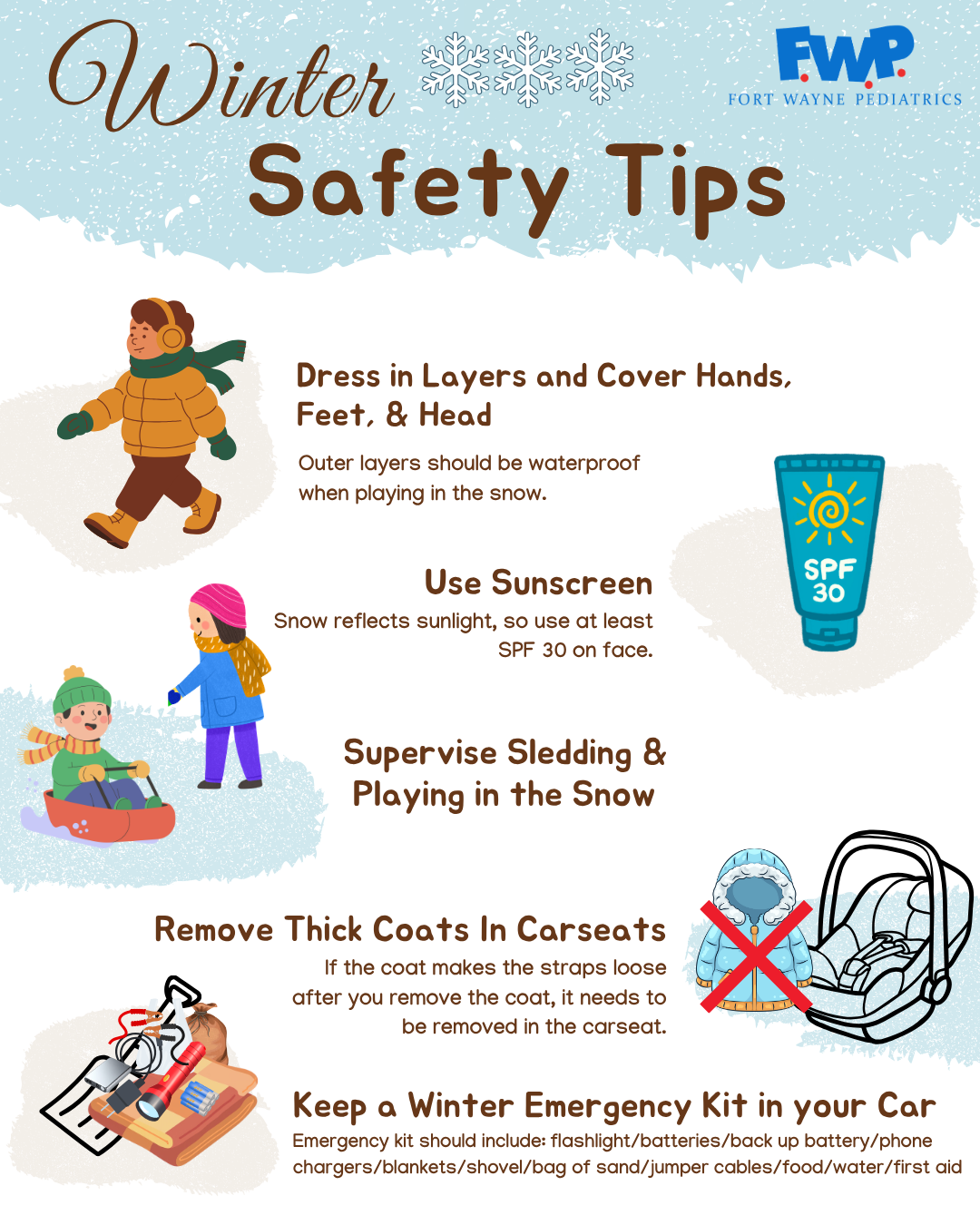
Use several light layers of clothing to insulate the body with warm air. Cotton and wool blends “breathe”, absorb sweat and keep the body drier; outside layers should be waterproof. Start with a cotton shirt, and then add a light sweater, wind-repellent jacket, pants and boots. Avoid overdressing, which can cause a prickly heat rash. Remove wet clothes as soon as kids come inside.
Most body heat is lost through the head, so keep your child’s head and ears covered, especially when the temperature is below freezing. Best choices: a hat that ties on and has ear flaps or earmuffs. Don’t let your child’s hands be bare. Mittens are better than gloves because the fingers will warm each other.
Sledding Safety
Help your child follow these simple rules for safer sledding:
- A responsible adult should be present at all times
- Sit face-forward (never head-first or standing)
- Go down the hill one at a time (one person per sled)
- Keep arms and legs within the sled
- Roll off a sled that won't stop
- Never ride a sled being pulled by a moving vehicle
- Wear a helmet
Location
- Choose a hill with a manageable slope and a long path
- Avoid slopes that end in a street, parking lot, pond, or other hazards
- Make sure the hill is free of jumps, bumps and obstacles, such as trees or fences
- Never ride into a snow bank – it may have a hidden object (rock or tree stump) within it
- Choose snowy hills and avoid icy surfaces
- Sled in the daylight when visibility is good
Winter-Proof Your Car
Your child might enjoy helping assemble this survival kit to keep in the car for possible winter emergencies:
- Large plastic trash bags and food storage bags. The large ones can be worn over coats for added warmth; cut slits for head and arms. Use smaller bags inside boots and over gloves.
- Work gloves and old mismatched gloves to protect hands in case you have to open the hood of the car or change a tire.
- One or two heavy blankets
- Energy foods, such as chocolate bars, peanuts and dried fruit
- De-icer spray for frozen locks and lugs on wheels in case of flat tire
- A snow shovel, ice scraper, and snow brush
- A large bag of sand or cat litter for traction
- A cell phone charger and coins for a phone call
- A flashlight and extra batteries
- Jumper cables
- First-aid kit
Fever
A fever is usually caused by infections from viruses (such as a cold or the flu) or bacteria (such as strep throat or ear infections). Fever is the body’s first line of defense in fighting infection. The fever itself is not the disease, only a sign that the body’s defenses are trying to fight an infection. However, a fever can make your child uncomfortable. A fever can’t be detected by feeling your child’s forehead so it very important to take his temperature. A rectal thermometer is recommended for infants under 2 months for the most accurate reading. If your child is older, you may use axillary or oral thermometers.
Fever is a temperature greater than or equal to 100.4.
Pain Medicine
Tylenol (acetaminophen) or Motrin (ibuprofen) may be used to reduce temperature. Do not alternate acetaminophen and ibuprofen when your child is running a fever. This approach can cause medication errors and could lead to potential side effects. Choose one medicine to give and then give it consistently. Always consult your doctor before changing the dose schedule or using these medicines in combination.
Contagiousness:
Your child can return to daycare or school after the fever is gone for 24 hours.
Expected Course:
Fevers usually last 3 to 5 days.
Call your doctor if:
- Child is 2 months or younger and has a rectal temperature of 100.4° F (38° C) or higher, call your pediatrician immediately
- Very irritable (e.g., inconsolable crying or cries when touched or moved)
- Signs of dehydration (very dry mouth, no urine for 8 hours or more, no tears when crying)
- Great difficulty swallowing fluids or saliva
- Fever present for more than 3 days
- Burning or pain with urination
- Stiff neck or severe headache
- Develops severe abdominal pain, persistent or severe vomiting or diarrhea
Common Cold
Colds cause nasal drainage, nasal congestion, sinus congestion, ear congestion, sore throats, hoarse voice, coughs, poor appetite, and red, watery eyes. Colds are caused by several respiratory viruses. Healthy children average 6 colds a year. GET A FLU SHOT!
At Home Treatment
- Wash hands often, especially after coughing or sneezing into your hands.
- When your baby has nasal drainage or congestion, you can use a nasal suction bulb to help clear their nose. Do this before feedings and sleeping. It is safe to do several times daily. Using saline nose drops before suctioning may also help if you do not see nasal drainage but hear nasal congestion.
- Nasal wash for older kids - flushing out the nasal passages with salt water by using a syringe or a neti pot. The water washes out mucus and other debris while keeping your nasal passages moist.
- Use a humidifier or cool mist vaporizer.
- Prop yourself up. At night, lie on a couple of pillows. Keeping your head elevated may make breathing more comfortable.
- Fluids: Encourage your child to drink adequate fluids to prevent dehydration. This will also thin out the nasal secretions and loosen any phlegm in the lungs.
- Encourage coughing. Coughing is one of the defenses against illness for the body. Coughing up mucus is very important for protecting the lungs from pneumonia. Suppressing a cough (with cough suppressant) works against that defense.
Contagiousness
Your child can return to daycare or school after the fever is gone for 24 hours and your child feels well enough to participate in normal activities. For practical purposes, the spread of colds cannot be prevented.
Expected Course
Fever 3 to 5 days, nasal discharge 7 to 14 days, and cough 2 to 3 weeks.
Call your doctor if:
- Fever present for more than 3 days
- Ear pain
- Sore throat up to 5 days (with other cold symptoms)
- Nasal drainage and congestion more than 2 weeks
- Coughs more than 3 weeks
- Wheezing (high pitched noise when breathing in or out)
- Shortness of breath, rapid breathing, grunting
- Chest pain